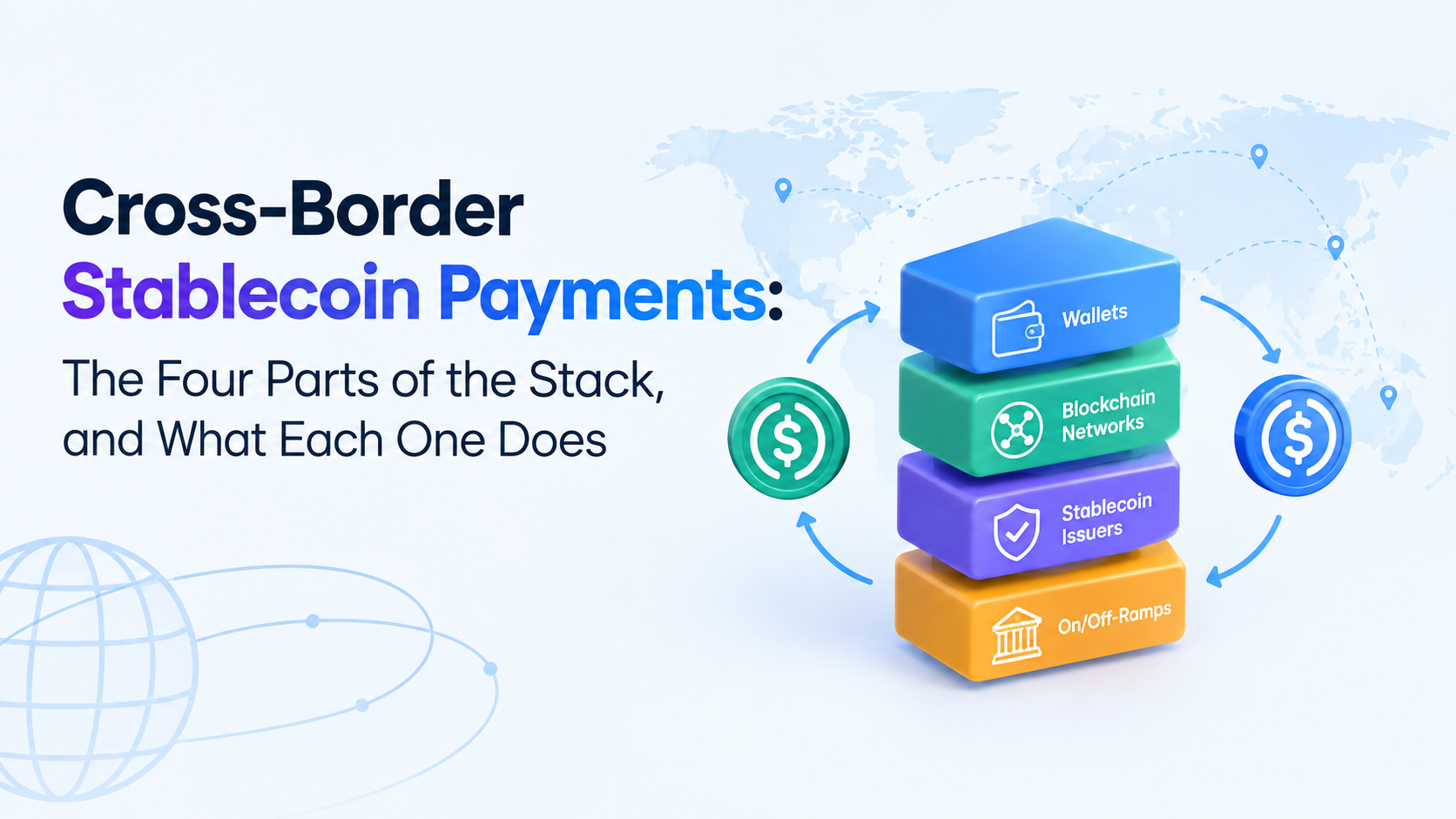

A cross-border stablecoin payment is four things working together: a coin issuer, a blockchain settlement layer, a wallet that holds the value in transit, and a payments layer that converts it back into usable money.
For most businesses, that means four separate infrastructure decisions: which stablecoin to use, which blockchain carries it, where the funds sit while in transit, and how USDT or USDC actually turns into naira, cedis, or dollars at the other end.
This guide breaks down what each part does, what a business gains when they work together, where the process can break, and what it looks like when one provider handles the full stack.
What is a Cross-border Stablecoin Payment?
It’s a way to move money between countries using a dollar-pegged token like USDT or USDC instead of banks. The sender converts local currency into a stablecoin, sends it wallet to wallet on the blockchain, and the recipient converts it back into their own currency.
For example, a Nigerian business could convert naira to USDT, send it to an overseas supplier, and let the supplier convert it into whatever currency they use. The blockchain just records the transfer; the actual currency conversion happens on the on-ramp and off-ramp.
The Four Parts of the Stack That Move the Money
Every cross-border stablecoin payment depends on four parts: the coin, the chain, the wallet, and the settlement layer. A business can source each part separately or use a provider that connects them through one integration.
The Coin: Why the Stablecoin You Pick Isn’t Interchangeable
Every stablecoin is a promise: $1 in, $1 out. What backs that promise is what changes.
USDT (Tether) and USDC (Circle) are the two most used for cross-border payments, but they’re not backed the same way. Tether holds a mix, including Treasury bills, gold, Bitcoin, and loans. Circle keeps USDC simpler: mostly cash and short-term US Treasuries.
For a business moving money across borders, simpler backing usually means a smoother redemption if something goes wrong. So the coin isn’t just a detail; it’s part of what you’re trusting with the payment.
The Chain: The Blockchain Doing the Actual Settlement
The blockchain is the rail your payment rides on. When a business sends USDT or USDC, the network it’s sent on records the transfer and updates both wallets.
Ethereum, Solana, Polygon, and Tron all carry stablecoin transfers, but fees and speed differ a lot between them. That gap matters: the same USDT payment can cost pennies or several dollars depending on the network. Tron tends to stay cheap and predictable even when Ethereum gets congested and fees spike.
For businesses moving frequent, often small payments into or out of African markets, that difference decides whether the network fee eats a real chunk of the transaction.
The Wallet: Where the Money Sits Mid-transit, and Who Controls It
A wallet holds the stablecoin before and after a transaction, and whoever controls its private keys controls the funds. With a custodial wallet, the provider holds those keys for you. With a non-custodial wallet, you hold them yourself, and take on the job of securing them, recovering access, and approving transactions.
For a business running payments through an API, wallet creation can just be automated. Breet’s crypto payment API generates a unique wallet address per transaction, so you’re not building and maintaining wallet infrastructure yourself.
The real risk: if a wallet is compromised, whoever holds the keys can move the funds. That’s why Breet manages the key infrastructure directly, with KYC/AML screening and access controls built into the flow.
The Settlement Layer: Turning the Stablecoin Back Into Naira, Cedis, or Dollars
Settlement has two sides: the on-ramp, where cash becomes a stablecoin before sending, and the off-ramp, where a received stablecoin becomes cash again. KYC and AML checks run alongside both to keep the provider compliant.
For an African business, that should end with NGN in a Nigerian bank account, GHS in a mobile money wallet, USD in a bank account, or another stablecoin in a wallet, whichever you actually need.
Breet’s API handles this automatically: once a payment webhook confirms the transaction, it converts the funds into USDT, USDC, NGN, or GHS and sends them to a bank account, mobile money wallet, or stablecoin address, with KYC/AML screening and PCI DSS controls built into the flow.
What a Business Gains When All Four Parts Work
The business case for stablecoin payments comes from how the four components work together. When the stablecoin payment and fiat settlement processes are integrated, the business can settle faster, reduce reliance on payment intermediaries, and keep less capital tied up in prefunded accounts.
Money Moves in Minutes, Every Day of the Week
A blockchain transaction doesn’t care about opening hours, correspondent bank windows, or public holidays. Once it’s sent, it can confirm and start settling right away, weekends included.
But that 24/7 rail is only half the story. The blockchain moves fast; how quickly the recipient can turn that into NGN, GHS, or USD depends on the off-ramp.
So the real end-to-end time is the network speed plus whatever the settlement provider adds on top.
Cost Drops Because the Middle of the Chain Disappears
Traditional cross-border payments can pass through correspondent banks, each adding fees or foreign-exchange costs before the recipient receives the funds. A stablecoin transfer removes those correspondent-bank steps and replaces them with an on-chain transaction followed by an on-ramp or off-ramp.
The savings come from changing the payment route and reducing the number of intermediaries involved, rather than simply discounting the same banking process.
Capital Stops Sitting Idle in a Prefunded Account
Traditional cross-border payments usually need prefunding: an institution parks money in the destination country ahead of time so payouts don’t wait on funds crossing borders. It works, but that cash is stuck instead of being used elsewhere.
Stablecoins change that. A business can convert funds only when a payment actually needs to go out, send it across the blockchain, and settle it into local currency, no separate cash pile sitting in every market.
For businesses running across multiple countries, that frees up working capital for things like inventory or operating costs, instead of it being locked up “just in case.”
Where the Stack Still Breaks, and What Actually Answers It
The blockchain can move a stablecoin quickly, but that does not guarantee a fast cross-border payment. Two risks matter most when moving between fiat and stablecoins: on/off-ramp friction and regulatory fragmentation.
The on/Off-ramp is Still the Weakest Link
This is where crypto meets the bank: converting naira, cedis, or dollars into a stablecoin before sending, and converting it back into cash on the other end.
The blockchain part is fast, often minutes. The cash-out part is where things slow down, held up by liquidity, banking checks, or whether a local payout method is even available.
That’s why the ramp matters as much as the chain. A cheap network is pointless if the provider can’t actually turn the funds into usable NGN, GHS, or USD when the business needs it. That takes real local liquidity, solid banking or mobile-money links, and a settlement process that doesn’t stall after the on-chain part is done.
Regulation is Not the Same in Every Country You Touch
A single stablecoin payment can cross several sets of rules at once: the rules on the stablecoin itself, on the provider, on the sender, and on the recipient, all depending on where each one sits.
That’s why licensing, KYC, AML checks, and transaction monitoring aren’t just paperwork; they decide how smoothly a payment actually goes through.
For a business working across Nigeria, Ghana, or the UK, this means picking a provider whose compliance covers all those jurisdictions, not just one. Worth knowing upfront: where your provider is licensed, what checks run on each transaction, and what happens if a payment gets flagged for extra verification.
Stop Assembling the Stack Yourself
A business using cross-border stablecoin payments does not need to become an expert in blockchains, wallet infrastructure, or stablecoin issuers. It needs the coin, chain, wallet, and settlement layer to work together. That makes the infrastructure decision a sourcing decision as much as a technical one.
Businesses already moving real payment volume on this rail do not need to assemble four separate providers and connect them themselves. Breet brings the stack together through one integration, from USDT and USDC wallet addresses to on-chain payment detection and settlement into NGN, GHS, USD, or another supported destination.
The result is one integration instead of four infrastructure problems to manage.