
You park 20,000 USDT in your futures account on Monday, and the earn page shows an estimated APR of 3%. By Thursday, it says 8%. You haven’t deposited anything or taken anything out. So what changed?
Most likely, you traded. With futures-linked yield, the USDT interest rate you get depends on eligible net Futures position value measured under the product’s snapshot rules, not how much you’re holding.
Why Your USDT Interest Rate Can Change When Your Balance Doesn’t?
Most people who want to earn interest on USDT picture something simple: put money in, get a percentage back, and let the platform worry about the rate. Futures-linked products don’t work that way.
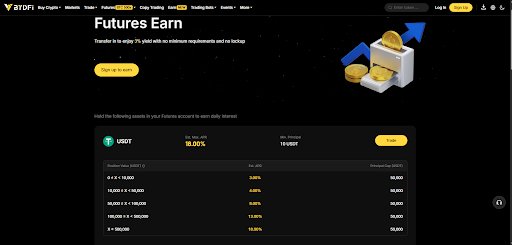
Take BYDFi Futures Earn, launched in September 2026. Eligible USDT in your Futures account earns a daily yield while staying available as margin. Eligible users who enable Futures Earn and maintain at least 10 USDT of eligible principal can receive the current 3% base estimated APR without holding an open Futures position. Anything above that depends on your Futures position value, roughly the combined size of your open futures positions.
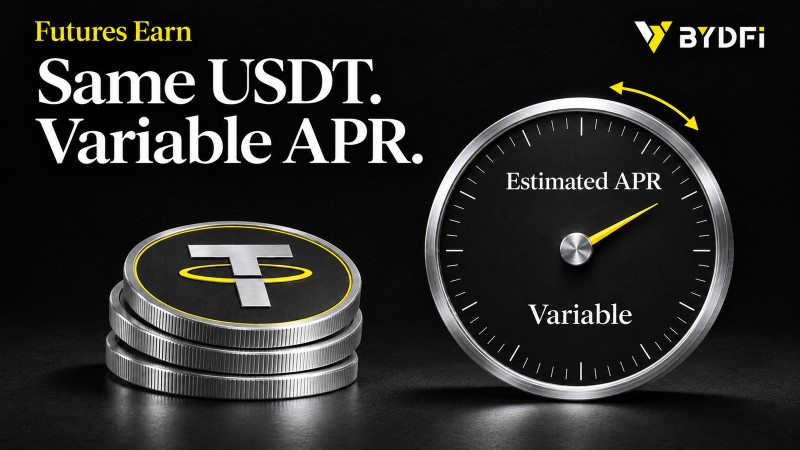
These are the tiers BYDFi listed at the time of writing:
| Futures position value (USDT) | Estimated APR |
|---|---|
| Under 10,000 | 3% |
| 10,000 to under 50,000 | 4% |
| 50,000 to under 100,000 | 8% |
| 100,000 to under 500,000 | 13% |
| 500,000 and above | 18% |
The tier rate only covers the first 50,000 USDT of principal, and the minimum is 10 USDT. Nothing is locked; you can switch it off at any time, and there’s no fee on the yield.
What Can Push the APR Up or Down?
Trading is the obvious one. Open about 60,000 USDT of BTCUSDT exposure, and you jump from the 3% tier to 8% without adding a single USDT. Close it, and you drop back.
Timing matters too. BYDFi reads your position value three times a day and averages it. Open that trade right after the first reading, and the daily average comes out to 40,000 USDT, which is the 4% tier.
Hedging pulls it down as well. Longs and shorts on the same asset are netted, so you don’t get credit for both sides.
Some positions don’t count at all. Only standard futures trades in your main account qualify, so Copy Trading, grid bots, Event Futures, sub-accounts, and COIN-M contracts don’t count. Liquidated portions stop counting too.
And BYDFi says the estimated APR may change with market conditions and platform rules, so check the live page before relying on these figures.
Principal, Accrued Yield and Wallet Balance Are Three Different Numbers
Much of the confusion comes from treating three figures as one.
Principal is the USDT that’s actually earning. BYDFi’s Help Center defines it as available balance plus frozen balance plus margin, minus bonus funds, so promotional credit earns nothing.
Accrued yield is what that principal has produced so far, and the app shows it on its own line next to yesterday’s interest.
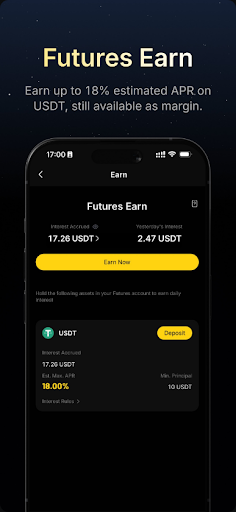
The wallet balance is the one most people check, and in a futures account it also moves with realized profit and loss, trading fees, and funding. A flat balance tells you very little about what you’ve earned. Interest is credited to your Spot account the following day, which helps explain why your Futures account balance alone does not show the interest you’ve received.
An APR change doesn’t touch your principal. All it changes is how quickly new yield builds up on top of it.
APR vs APY: Which One Are You Looking At?
APR is a flat annual rate. APY assumes the yield is reinvested and compounds, so it looks bigger for the same underlying rate. Futures Earn quotes APR, and principal × APR ÷ 365 gives an illustrative daily estimate (assuming unchanged eligible principal and APR), so treat it as simple interest.
A Worked Example: 20,000 USDT, Three Different Payouts
Say you have 20,000 USDT of principal and the tiers above apply.
No open positions puts you at 3%: 20,000 × 3% ÷ 365 is about 1.64 USDT a day, or 49.32 USDT over 30 days.
An average position value of 60,000 USDT gets you 8%, about 4.38 USDT a day or 131.51 USDT over 30 days.
Cut that to 30,000 USDT, and you’re at 4%, about 2.19 USDT a day.
It’s the same balance every time, yet the payout more than doubles between the first and second case.
Is It Worth Trading Bigger to Reach a Higher Tier?
Not if the yield is your main reason. Moving from 3% to 8% earns you about 2.74 USDT more a day on this balance. A 1% move against a 60,000 USDT position costs 600 USDT. That’s roughly 219 days of extra yield lost to one ordinary price swing.
The higher tiers suit traders who would hold big positions anyway; for them it’s extra return on margin they already needed. Sizing up just to earn interest gets the logic backwards.
What to Check Before You Choose a Crypto Interest Account
The headline rate is usually the least useful part of any comparison, so look past it.
Start with what drives it. A promotional rate, a rate that follows borrowing demand, and one tied to your own trading can show the same number today and look very different in three months.
Check whether it’s APR or APY, and how the balance is measured, since snapshots, caps, and minimums decide how much of your money actually earns. A crypto interest account with a lock-up is also a different animal from one where your USDT stays usable.
And ask what could shrink the principal. In a futures account, that includes your own losses and liquidation.
For active futures traders, Futures Earn is easy to justify, since idle margin earns something without leaving the trading account. If you don’t plan to trade much, plan around the 3% base rate. The “up to 18%” headline needs a position value of 500,000 USDT or more.
Risk note: Cryptocurrency trading involves significant risk. Leveraged products such as perpetual futures can magnify both gains and losses, and positions can be liquidated. APRs are estimates and can change. BYDFi’s products are not available in all jurisdictions. Check the live Futures Earn page and its rules before relying on any rate mentioned here.