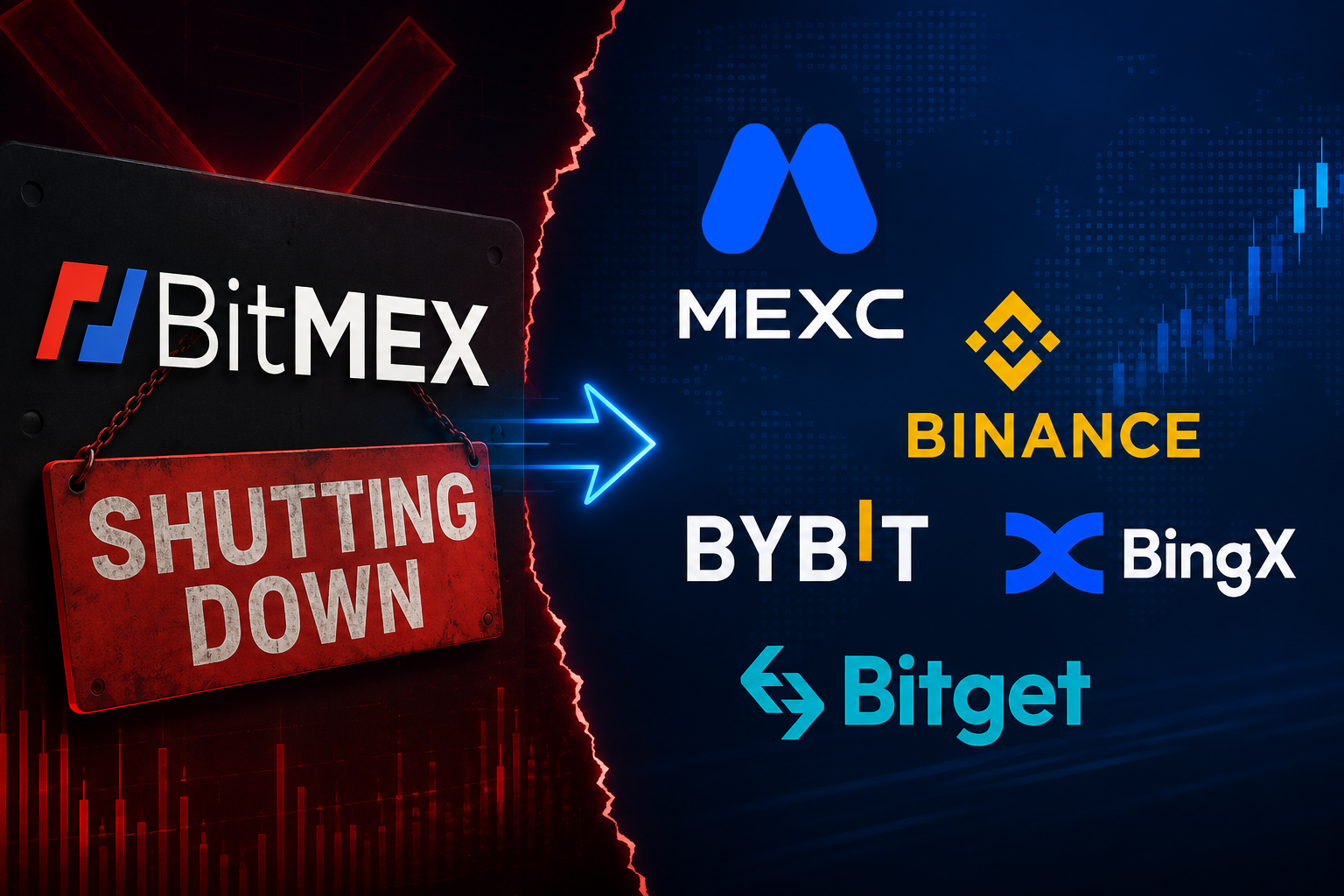

BitMEX confirmed on July 23, 2026 that it will cease all operations on September 23, 2026 at 04:00 UTC, ending an 11-year run as one of crypto’s original derivatives venues. New account registrations are already closed, and from August 26 the exchange will stop accepting new positions, allowing only reductions until everything is force-closed at shutdown. For traders still holding open contracts or watchlists on BitMEX, the practical question isn’t whether to move, it’s where.
Quick Answer
- Best overall: MEXC — the widest selection of altcoin perpetual futures, an accessible interface, and low base trading fees.
- Best for liquidity: Binance — the deepest order books across major and mid-cap assets.
- Best for professional derivatives: Bybit — advanced trading tools and an institutional-grade futures platform.
- Best for leverage and copy trading: BingX — accessible derivatives paired with integrated social trading.
- Best for high-speed perpetual trading: Bitget — a strong futures ecosystem with copy trading and risk controls.
Key Takeaways
- Deadline Action: BitMEX’s shutdown means users must close positions and withdraw funds before September 23, 2026, or face ongoing custody fees.
- Evaluation Criteria: The right replacement depends on available markets, liquidity, fee structure, leverage ceilings, and risk-management tools—not just brand recognition.
- Market Selection: Altcoin traders generally get more value from exchanges listing hundreds of perpetual contracts rather than only large-cap pairs.
- True Trading Costs: Real trading costs include spreads and funding rates alongside maker/taker fees, so headline numbers only tell part of the story.
- Platform Health: Security posture, proof of reserves, and platform stability matter as much as features, especially after watching a long-running exchange wind down.
Why BitMEX Is Closing, and Why It Matters for Traders
BitMEX essentially invented the 100x leverage perpetual swap in 2016, and its XBTUSD contract became a central price-discovery tool for the industry. But by mid-2026 its daily derivatives volume had fallen to roughly $300 – 350 million, with open interest under $200 million – a fraction of what Binance and Bybit now process daily. HDR Global Trading, the company behind BitMEX, said the board closed the exchange after a strategic review found no viable buyer. The firm reports it never lost customer funds to a hack in over 11 years, but reputational fallout from a 2020 Bank Secrecy Act case, combined with rivals matching and exceeding its leverage and listings, eroded its market share well before the final announcement.
That backdrop matters for evaluating alternatives: the platforms below aren’t just “next in line” – several actively out-competed BitMEX on the metrics that drove traders away from it, particularly contract variety and liquidity depth.
What Should You Look for in a BitMEX Alternative?
- Futures market coverage: Can you actually reopen your BitMEX positions elsewhere?
- Liquidity depth: Will your order size move the market?
- Real trading fees: Maker/taker rates, funding rates, and withdrawal costs combined.
- Platform stability & security: Uptime history, proof of reserves, and insurance funds.
- Risk management tools: Margin modes, liquidation mechanics, and TP/SL automation.
- Ease of migration: API compatibility, TradingView support, and custom order types.
Note: Rankings below prioritize active altcoin derivatives traders rather than beginners making their first futures trade.
Comparison Table: Best BitMEX Alternatives at a Glance
| Exchange | Best For | Perpetual Contracts | Futures Taker Fee | Max Leverage | Key Strength | Main Limitation |
| MEXC | Altcoin futures | ~1,000+ | 0.02% | Up to 500x (BTC/ETH) | Largest altcoin derivatives selection | Not available in some jurisdictions |
| Binance | Liquidity | Extensive, large-cap focus | ~0.05% | Up to 125x | Deepest liquidity | More selective altcoin listings |
| Bybit | Professional futures | Large, broad coverage | ~0.055% | Up to 125x | Advanced trading platform | Smaller altcoin selection than MEXC |
| BingX | Copy trading | Large | ~0.05% | High, varies by pair | Social trading ecosystem | Thinner liquidity on niche contracts |
| Bitget | Active futures | Large | ~0.06% | Up to 125x | Copy trading + derivatives | Fewer micro-cap listings |
Fees shown are standard, non-VIP base rates and can change with token discounts, promotions, or region. Leverage varies by asset and jurisdiction. Always confirm current numbers on each platform before trading.
The 5 Best BitMEX Alternatives for Altcoin Traders
1. MEXC: The Best BitMEX Alternative for Altcoin Futures
MEXC currently lists well over 1,000 perpetual futures contracts, more than any other major exchange, and ranks #4 worldwide by futures open interest behind Binance, Hyperliquid, and ByBit, ahead of Gate.io, and CoinW (According to CoinGecko’s derivatives exchange tracker). That combination of breadth and real capital commitment (harder to inflate than raw volume) is why it edges out the field for traders hunting altcoin exposure specifically.
Its fee structure reinforces the case: MEXC charges 0% for maker orders and roughly 0.02% for taker orders on USDT-margined futures, well below the 0.05%–0.06% taker rates typical of Binance, Bybit, and Bitget’s standard tiers. Leverage tops out around 500x on BTC and ETH pairs, tiering down as position size grows – a high capital-efficiency tool for experienced derivatives traders transitioning off BitMEX.
- Strengths: Broadest perpetual futures catalogue, highly competitive fees, fast listing cadence of new altcoins, multiple order types, robust mobile and desktop apps.
- Limitations: Availability depends on jurisdiction; liquidity on the smallest, newest contracts can be thin compared with established large-cap pairs.
For traders migrating from BitMEX who require high leverage and the widest array of altcoin perpetual futures, MEXC stands out as the primary replacement exchange.
2. Binance: Best BitMEX Alternative for Deep Liquidity

Binance remains the largest exchange by trading volume and order-book depth across major and mid-cap crypto futures, which matters most to traders running larger position sizes who need to enter and exit without excessive slippage. Its futures taker fee sits around 0.05%, with maker fees near 0.02%, and a 25% discount is available for traders paying fees in BNB.
- Strengths: industry-leading liquidity, a mature risk engine, and a broad ecosystem spanning spot, futures, and earn products.
- Limitations: Binance is more selective about which altcoins get perpetual listings, and regulatory availability varies significantly by country.
3. Bybit: Best BitMEX Alternative for Professional Derivatives
Bybit built its reputation on a sophisticated futures interface, advanced charting, and multiple margin modes aimed at experienced traders and API users. Standard futures fees run about 0.01% maker and 0.055%–0.06% taker, with meaningfully lower rates at higher VIP tiers. Bybit is also migrating EEA clients to a MiCA-licensed entity through 2026, which is worth noting for European traders weighing regulatory clarity.
- Strengths: advanced futures platform, reliable execution, strong institutional tooling, multiple margin and collateral options.
- Limitations: its altcoin perpetual selection is narrower than MEXC’s, and some regions face access restrictions.
4. BingX: Best Alternative for Copy Trading and Futures

BingX pairs an accessible futures interface with one of the largest copy trading communities in the industry, letting less experienced traders mirror strategies from established derivatives traders. Its base futures taker fee, around 0.05%, undercuts Bybit’s and Bitget’s standard rates, and its VIP progression is comparatively easy to reach.
Strengths: large copy trading ecosystem, approachable interface, decent derivatives coverage, competitive taker fees.
Limitations: liquidity thins out on less-traded contracts, and it offers fewer advanced institutional-grade features than Bybit or Binance.
5. Bitget: Best Alternative for Token Discounts

Bitget has built a strong perpetual futures platform alongside heavy investment in copy trading and bot tools. Standard futures fees run close to 0.06% taker, slightly above Bybit’s, but Bitget’s BGB token discount program can meaningfully lower costs for high-frequency traders over time — potentially saving more annually than Bybit’s equivalent token discount, according to fee comparisons run in early 2026.
- Strengths: solid futures liquidity, effective risk controls, strong copy trading tools, growing altcoin derivatives coverage.
- Limitations: fewer niche or micro-cap perpetual markets than MEXC, and some advanced features are gated behind higher trading tiers.
Which Exchange Is Best for Your Trading Style?
| If You Want… | Best Choice | Why |
| The most altcoin perpetual markets | MEXC | Broadest selection of altcoin futures |
| Lowest execution slippage on size | Binance | Deepest liquidity |
| Professional derivatives tools | Bybit | Advanced trading platform |
| Copy trading | BingX | Largest social trading focus |
| Active futures trading with strong incentives | Bitget | Balanced fees, copy trading, and derivatives |
How to Move from BitMEX Without Losing Momentum
- Close or reduce existing positions. From August 26, 2026, BitMEX will only allow position reductions, not new entries — plan around that date.
- Export your trading history for tax records and strategy review before account access changes.
- Compare funding rates on your target exchange before opening equivalent-sized positions; funding can differ meaningfully between venues even on the same pair.
- Rebuild watchlists and API connections, checking that your new platform supports the order types and automation your strategy depends on.
- Test execution with small positions first to gauge slippage and fee impact before committing full size.
Conclusion
No single exchange perfectly replicates what BitMEX offered at its peak — that’s part of why it struggled to compete as rivals expanded faster. Traders focused on the broadest altcoin futures markets are likely best served by MEXC, while those prioritizing maximum liquidity may prefer Binance, professional derivatives traders may lean toward Bybit, copy traders toward BingX, and active futures users toward Bitget. Before migrating any capital, compare each platform’s current available markets, fees, funding rates, and regional access — these details shift often enough that it’s worth checking each exchange’s official fee schedule directly.
FAQ
Is BitMEX Shutting Down Permanently?
Yes. BitMEX will permanently close on September 23, 2026. New registrations have ended, and from August 26, only position reductions are allowed. Assets left after closure may incur custody fees.
What is the Closest Alternative to BitMEX?
Bybit offers a similar derivatives-focused experience, while MEXC provides a broader range of altcoin perpetual futures.
Which Crypto Exchange Has the Most Altcoin Perpetual Futures?
MEXC lists the largest selection of perpetual futures and adds new altcoin contracts frequently.
Can I Transfer BitMEX Positions Directly?
No. You must close positions, withdraw funds, and reopen trades on the new exchange.
What Should I Check Before Switching?
Compare security, proof of reserves, supported markets, fees (including funding rates), leverage, regional availability, and KYC requirements.