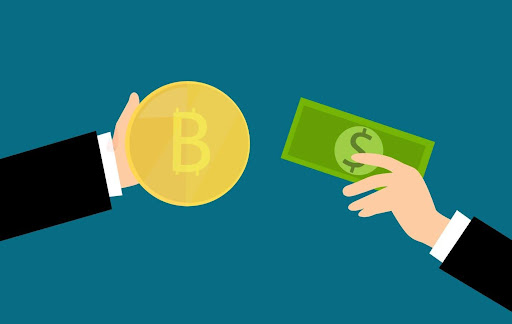

Cryptocurrency is a type of virtual or digital money that may be transferred from person to person without the need for an intermediary agency or organization.
For example, if you want to pay for food, you must either use state-issued currency or a bank transfer facilitated by the payer and payees’ banks. If, on the other hand, the grocery shop accepted Bitcoin, the world’s largest and most well-known Cryptocurrency, denoted by the ticker symbol “BTC”, you’d be able to simply transfer funds from your digital wallet to theirs without incurring any costs or fees to an intermediary, or any delays.
With Bitcoin, the infrastructure that enables payment is decentralized; no one person, organization, or interest controls it.
Chain of Command
It all works with blockchain technology. Blockchains are immutable digital ledgers maintained by volunteers, regulated by regular people’s communities, and made available to anybody who wants to participate.
Volunteers provide their time and effort in return for the opportunity to earn Bitcoin, and encryption technology makes it nearly hard to defraud the system.
When you conduct a Bitcoin transaction, volunteers all over the world record it in their copies of the relevant ledgers. When a particular amount of transactions is recorded, a block containing those transactions is added to a lengthy chain of prior blocks, representing the currency’s canonical history.
To add a block to the blockchain, first validate it. To do so, you must either accurately guess a 64-character alphanumeric string with trillions of potential permutations, or stake your own money for the privilege.
Suppose you are fortunate enough to be chosen because you staked enough of your assets to tip the odds in your favor or because your computer rig was powerful enough to make the accurate guess (or the closest guess within a 10-time limit). In that case, you will need a majority of 51% of the volunteers to agree yours is a correct transaction record.
If you tried to claim that there was more Bitcoin in an account than there was, the majority would reject it. To cheat the system, you must control at least 51% of the network’s votes. In both cases, the expense would be exorbitant.
When your block is uploaded to the blockchain, you will be awarded a tiny quantity of a certain Cryptocurrency.
There are no Cryptocurrency coins or notes; simply transaction records that show who owns what assets.
Cryptocurrencies can be used to pay for products and services, exchanged for other cryptocurrencies, or retained for investment purposes.
How to Trade Cryptocurrency?
A trader may examine current values for a variety of tokens on Bitcoin Decode as well as observe how they’ve performed in the previous hours, days, weeks, months, and years.
Exchanges will frequently display tokens that are in trend – upwards and in price – downwards, popular tokens, new tokens, and so on. Users may use all of this information to determine which coins to buy and sell.
When you buy a Cryptocurrency, it implies that someone else is selling it, with the exchange acting as a middleman. When there are more buyers than sellers, the value of a token rises, and vice versa.
How and when an investor decides to purchase is most likely determined by his or her investment strategy, what they want to earn, and the level of risk each trader is willing to accept as part of the deal.
Swing Trading
Swing traders hold coins for extended periods, watching asset values over many weeks to select which assets to purchase, sell, and hold.
Analyzing market fluctuations over longer periods can assist traders in making more sensible and informed decisions, but it may take more skill and discipline to not act impulsively on changes.
Day Trading
To profit from market moves, day traders buy and sell tokens on the same day. This provides the opportunity for rapid profits while mitigating the risk of significant price reductions from one day to the next.
Furthermore, because day trading is such a short-term approach, it precludes investors from riding out price drops that may recover over time.
Position Trading
Position trading offers a long-term perspective on Cryptocurrency investing. Position traders buy coins with the expectation of achieving long-term gains and are only somewhat bothered about daily volatility.
Position trading also offers the advantage of allowing you to gradually create a portfolio, beginning with a small investment and building it over time. The trade-off is that investors cannot expect immediate profits.
What Influences Changes in Prices
Several elements might influence the price of a cryptocurrency, but supply, demand, and sentiment are valuable indicators for forecasting trends.
When demand is fulfilled by an adequate supply or more supply than is required, prices tend to remain steady or decline. In cryptocurrency, supply is governed by how coins are mined.
For example, next year, the amount of Bitcoin awarded to miners who successfully add a block to the network will be cut in half, from 6.25 BTC to around 3.125 BTC.
This sharp decrease in the rate of new BTC issuance might, in principle, force prices upward as supply becomes limited. However, if demand drops considerably, the supply compression will be minor.
Public Backing
Demand is the opposite side of the coin. When more people want to acquire something, those who can afford it are more ready to pay a premium for its scarcity. If, for example, a prominent public figure stated that they felt a coin would become extremely valuable, their endorsement may stimulate interest and cause demand to outpace supply, driving prices upward.
On the other side, if a currency is seen to be undervalued, such as if there are reports of liquidity concerns behind the scenes, demand may decline, and sellers may be forced to accept lower prices to sell their coins, resulting in price drops.
Should You Invest in Cryptocurrency?
Crypto enthusiasts frequently say that it can act as an inflation hedge, is faster and cheaper than centralized fiat currencies, is free of entrenched interests, and is private.
Critics argue that cryptocurrencies are unstable, volatile, and lack real-world usefulness. Environmentalists argue that many Cryptocurrency systems are inappropriate due to the massive quantities of energy they use.
The benefits and drawbacks of trading cryptocurrencies are nearly entirely subjective and are determined by how you feel about the notion of Cryptocurrency.