

The cryptocurrency bug began in 2009 when the anonymous Satoshi Nakamoto published a whitepaper about Bitcoin—an ambition that came to life within the same year and began circulating in exchanges by 2010. Since then, the altcoin market began to grow with new cryptocurrencies created to challenge Bitcoin, eventually evolving into an entire digital financial ecosystem that has trickled to today.
While you may be familiar with purchasing crypto through exchanges, it’s important to know that each listing comes from a source. There are many ways by which new coins enter the market, dictated by the underlying blockchain technology involved in each network. Like how central banks mint fiat money, cryptocurrencies can also be minted in a process that involves validating transactions on the network. From mining Bitcoin to staking Cardano and employing an algorithm to release new TPR coins in predetermined intervals, developers have come up with various ways to allow coins to enter the market in a decentralised fashion.
In that regard, the absence of third-party involvement allows—and encourages—user participation, essentially creating an economy wherein you can “earn” coins by participating in the network. Here are some of the most popular methods used by blockchains like Bitcoin, Ethereum, Cardano, and more.
Proof-of-Work (PoW)

If you’ve been following Elon Musk’s Twitter saga and his recent accusations of Bitcoin being an unsustainable network, then you’ve, more likely than not, heard of the PoW consensus model. This is a mining algorithm that older networks, such as Bitcoin, Ethereum, and Litecoin, notoriously employ. The idea is for miners to compete against one another to solve a difficult mathematical problem (a hash) to verify a block of transactions on the blockchain.
The first miner to solve the code will then broadcast the solution across every node on the network, and all the ledgers will be updated with the new version of history. But with millions of miners competing for that one victorious spot (which will gain all the block rewards from the cycle), competition is tough—and the only way to gain an edge is to use rigs packed with powerful graphics cards, which speed up the computer’s information-processing ability.
While this may sound impressive at first, the feat comes at the cost of a huge financial investment (mining rigs can cost thousands each!) and harm to the environment due to the massive energy required to sustain mining operations. Musk’s concerns weren’t uncalled for—Bitcoin mining consumes more energy than the entirety of Ireland. Experts and governments are wary about its unsustainability, hence why PoW isn’t popular amongst newer altcoins.
Proof-of-Stake (PoS)
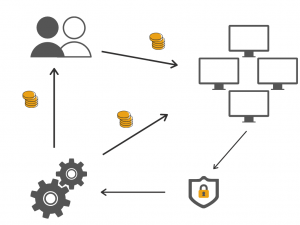
The PoS consensus algorithm is a fresh take on a decentralized network validation model that isn’t nearly as expensive and resource-heavy as the PoW. In particular, this cryptocurrency “earning” method involves staking, where you surrender holdings to the system, allowing them to power the network. Generally, the higher the stake, the higher your chances are of generating blocks. So while no specialized machine or high-end graphics cards are required to efficiently participate in a PoS network, a significant holding is required to influence the blockchain. As a result, many join stake pools where members’ funds are pooled together to cumulatively operate a node.
A downside is that most networks will lock your coins in until the full stake cycle is complete, which usually takes up to a year as PoS profits are earned through annual interest. Consequently, it’s a method that’s only ideal if you intend to leave your holdings unspent for the long term.
Nevertheless, the PoS is popular amongst newer altcoins as it encourages community participation without negatively impacting the environment. EOS, Cardano (ADA), and Algorand (ALGO) are some popular blockchains that employ this consensus model. Ethereum will also begin fully implementing it once the network has transitioned to 2.0. Furthermore, unlike the PoW, PoS has a small barrier of entry—a smartphone is enough to start staking coins!
Proof of Space And Time (Proof of Space and PoT)
One of the newest “proof” consensus models is the Proof of Space and Time, which utilizes a combination of the Proof of Space and PoT to efficiently validate transactions on the blockchain. The Chia Network (XCH) is the most popular and one of the only networks to use this combination.
Rather than devoting massive energy toward calculating mathematical equations, the Proof of Space requires users to dedicate hard drive storage to store and generate random numbers. However, this method also involves a fair share of competition. Every time the blockchain broadcasts a challenge for generating the next block, each “farmer” (user) can search through their “plots” (storage) for the correct hash to win the competition.
Like a bingo game, the more cards you have, the easier it is to hold the winning number. In Proof of Space, the more storage you own, the more random numbers you can have in storage, increasing your chances of winning the challenge. In conjunction, the PoT will ensure temporal efficiency and consistency within the blockchain, essentially managing the time between each block challenge.
While the Proof of Space and PoT combination isn’t widely used across cryptocurrencies, it’s already causing a shortage of SSDs, sending red flags to environmentalists and causing yet another essential item shortage amongst gamers.
Passive Earning
Another uncommon coin minting process involves passive earning, which is just as simple as it sounds. A dedicated cryptocurrency wallet, which is native to a particular blockchain, will automatically use untouched holdings to power the network and generate new tokens. It’s similar to the PoS but a lot simpler for investors as there’s an even smaller technological barrier of entry.
Generally, leaving coins in the blockchain’s native wallet is enough to begin the passive earning process. Depending on the network, interest is calculated at various intervals. For instance, for the anchored coin, The People’s Reserve, that interval occurs every day—so if you were to spend some holdings, only the remainder will be calculated against the interest rate in the next cycle (which will occur on the next day).
Apart from the methods above, there are plenty more ways blockchains have creatively allowed investors to participate in the network, from validating transactions to operating full nodes and minting new tokens. As the cryptocurrency space evolved throughout the years, the process has become significantly simpler and more user-friendly—and it’s likely to continue with that trend in the future.